
Low ceilings do not mean a room has to settle for flat or forgettable lighting. The important decision is how much vertical space the fixture can use while keeping the room comfortable, proportionate, and visually open. In some spaces, a flush mount is the clearest answer. In others, a compact chandelier can still work beautifully when it is placed over furniture rather than a walkway.
This comparison explains how flush mounts and chandeliers differ in depth, scale, placement, and visual effect so you can choose the better option for a low ceiling.
What counts as a low ceiling?
In many homes, an 8-foot ceiling is treated as the standard low-ceiling condition, though older buildings and remodeled areas may be lower. Nine feet offers more flexibility but still requires careful attention to the fixture's total drop. The true constraint is not the ceiling number by itself. It is the remaining clearance below the installed light.
Measure from the finished floor to the ceiling, then subtract the fixture's complete projection, including its canopy and any required stem, chain, or suspension hardware. For open walking areas, plan for roughly 7 feet of clearance below the fixture as a common reference and confirm all local code and site requirements with a qualified installer.
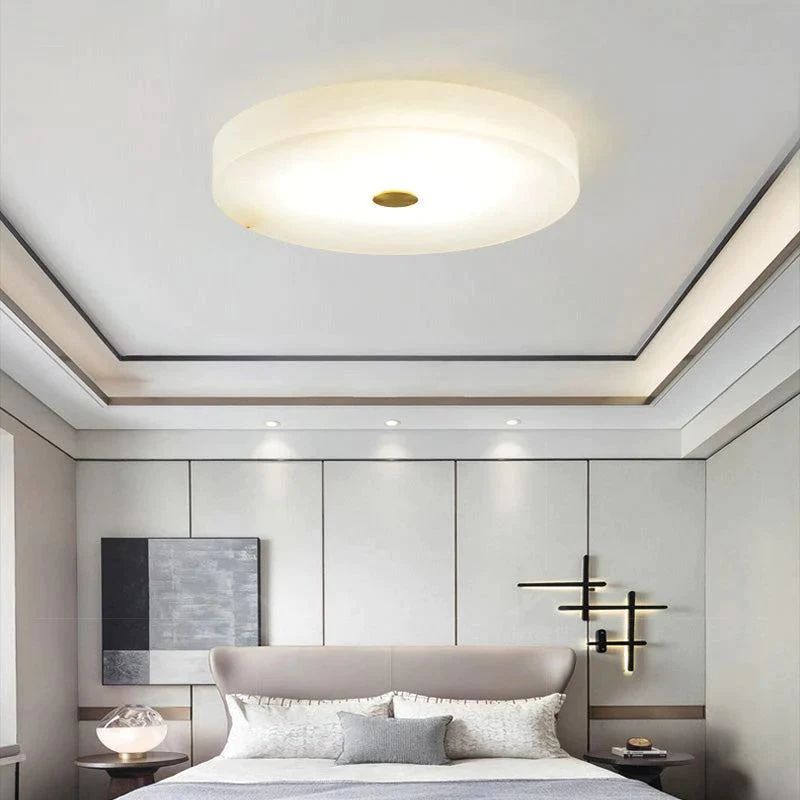
How a flush mount works
A flush mount sits directly or nearly directly against the ceiling. Its shallow profile keeps more of the room's vertical volume visible, which can make a compact bedroom, hallway, closet, or living area feel less interrupted. A semi-flush fixture hangs slightly below the ceiling and creates a little more shadow and dimension while still using less height than most chandeliers.
The main advantage is clearance. A flush mount can usually be placed in the center of an open room without creating the low point that a suspended fixture would. It can also distribute general light without competing strongly with furniture or artwork.
Explore the flush mount collection to compare round, square, stone, metal, and glass forms. Always check the listed fixture depth because the word “flush” does not indicate one universal measurement.
How a chandelier changes the room
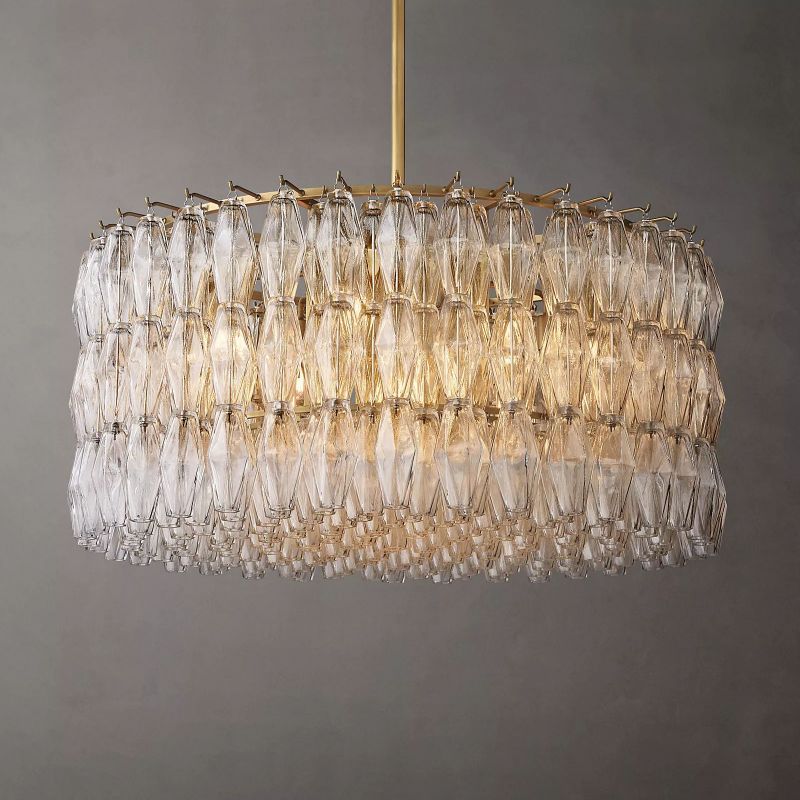
A chandelier extends into the room and creates a stronger focal point. Its arms, shades, crystals, globes, or stone elements add visible depth that can help define a dining table, bed, or seating group. This is valuable when the room needs a decorative anchor, but it also means the hanging height must be planned carefully.
On a low ceiling, a chandelier is usually most successful over a fixed surface where people will not walk underneath it. A dining table is the classic example. A compact chandelier may also be centered over a bed or sometimes a kitchen island, provided its scale and clearances suit the layout. It is less appropriate in the middle of a low-ceiling hallway or other open traffic path.
Browse the chandelier collection when you want to compare compact and suspended forms, and read every dimension before judging whether a design is suitable.
Flush mount vs chandelier: a quick comparison
| Consideration | Flush mount | Chandelier |
|---|---|---|
| Vertical space | Uses minimal ceiling depth | Requires a planned hanging zone |
| Best location | Open room centers and walkways | Above tables, beds, islands, or defined zones |
| Visual effect | Quiet, clean, integrated | Sculptural, layered, focal |
| Sizing priority | Diameter and projection | Diameter, body height, and total drop |
Choose a flush mount when clearance comes first
A flush mount is usually the safer starting point for an 8-foot ceiling when the fixture is over an open floor. It works especially well in bedrooms with a central walking route, small living rooms, entry passages, dressing rooms, and corridors. A broad low-profile fixture can have presence without making the ceiling feel lower.
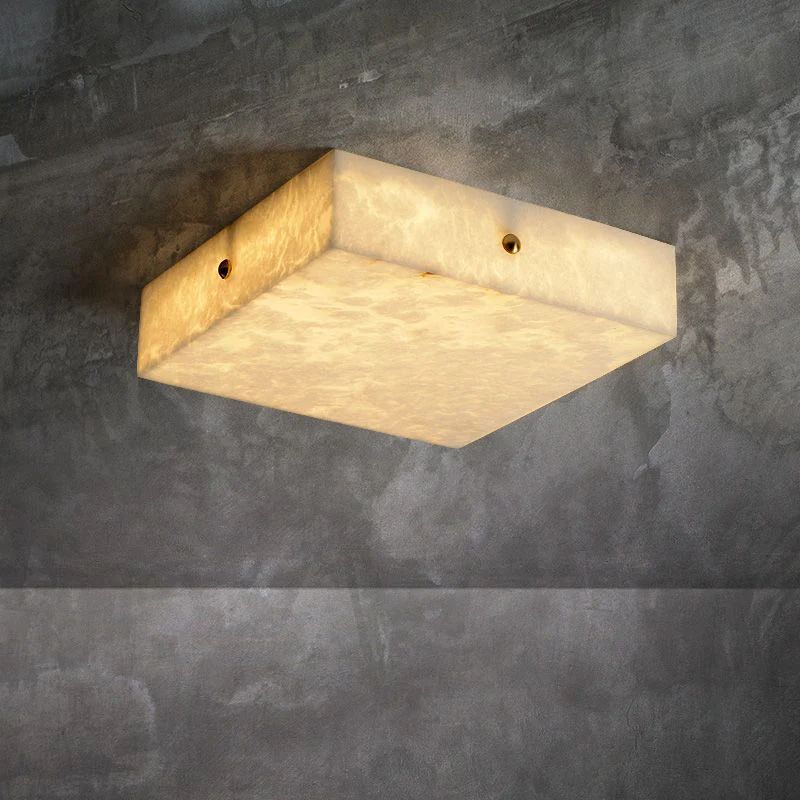
Scale still matters. A tiny light in a large room can look temporary, while an oversized disc or square may crowd ceiling details. Use the room's width, furniture layout, and any tray ceiling or molding as boundaries. A round fixture can soften a square room; a square flush mount can echo rectilinear paneling or cabinetry.
Choose a chandelier when the furniture protects the drop
A low ceiling can still support a chandelier when the fixture is centered over something that prevents people from passing below it. In a dining room, the table creates that protected zone. The bottom of a dining chandelier is often planned around 30 to 36 inches above the tabletop for an 8-foot ceiling, then adjusted for the fixture, table, sightlines, and actual ceiling height.
A compact chandelier over a bed can also create a focused composition, but account for the height of the mattress and anyone sitting or standing on it. In a living room, a chandelier above a fixed coffee table may appear workable, yet furniture moves; preserve safe clearance for realistic use rather than relying on the current arrangement alone.
For dining-specific placement, see how high a chandelier should hang above a dining table. For width and proportion, use the dining room chandelier sizing guide.
Consider a semi-flush fixture as the middle ground
A semi-flush mount leaves a small gap below the ceiling. This can create more visible dimension and allow light to interact with the ceiling while preserving more headroom than a suspended chandelier. It is useful when a true flush mount feels too quiet but the room cannot comfortably accept a long drop.
Do not choose by category name alone. Some semi-flush designs project only a little; others are deep enough to present the same clearance problem as a compact pendant. Compare the precise height of the entire installed fixture.
Let material control the visual weight
Low ceilings benefit from materials that suit the desired atmosphere without becoming visually heavy. Alabaster can diffuse light through natural texture and make a simple silhouette feel substantial. Clear glass keeps more of the ceiling visible. Crystal reflects light and adds a formal, decorative quality, though a dense arrangement can appear larger than its stated dimensions.
A dark metal frame creates stronger contrast against a pale ceiling, while a light stone or glass form may blend more softly. If natural stone appeals to you, compare designs in the alabaster lighting collection. For material differences, the guide to alabaster versus glass lighting offers a useful visual comparison.
Do not overlook brightness and glare
Fixture type does not by itself determine how well a room will be lit. Shade material, bulb position, number of light sources, room surfaces, and fixture output all affect the result. A low ceiling places the light closer to the main field of view, so exposed or intense sources may create uncomfortable glare.
Use the bulb type and wattage specified for the product. If adjustable brightness is important, confirm that the fixture, bulbs, and controls are explicitly compatible; do not assume every LED or decorative light can be dimmed. Support the ceiling fixture with lamps or wall lights when the room needs task or accent lighting.
Questions to answer before buying
- What is the exact finished ceiling height?
- Will anyone regularly walk below the fixture?
- What is the complete installed depth, including canopy and suspension?
- Does the fixture relate to a table, bed, island, or open room center?
- How does its diameter compare with the room and nearby furniture?
- Will its material feel light and open or intentionally substantial?
- Are the ceiling box and support appropriate for the product's weight?
- Have electrical and local code requirements been professionally verified?
Final thoughts
For an open area with a low ceiling, a flush mount usually offers the clearest combination of headroom and general light. A chandelier becomes the stronger choice when a table, bed, or other fixed feature creates a safe hanging zone and the room benefits from a decorative focal point.
Measure the full drop, protect clearance, and judge visual weight as carefully as physical size. With those decisions made first, both categories can produce a refined result.